For decades, maintenance has been treated as a line item — a necessary cost to keep things running. Reactive service was the norm, and unless something broke, the books were silent.
But in today’s world — where insurance premiums are rising, capital is harder to justify, and operating conditions are more complex — this view is dangerously outdated.
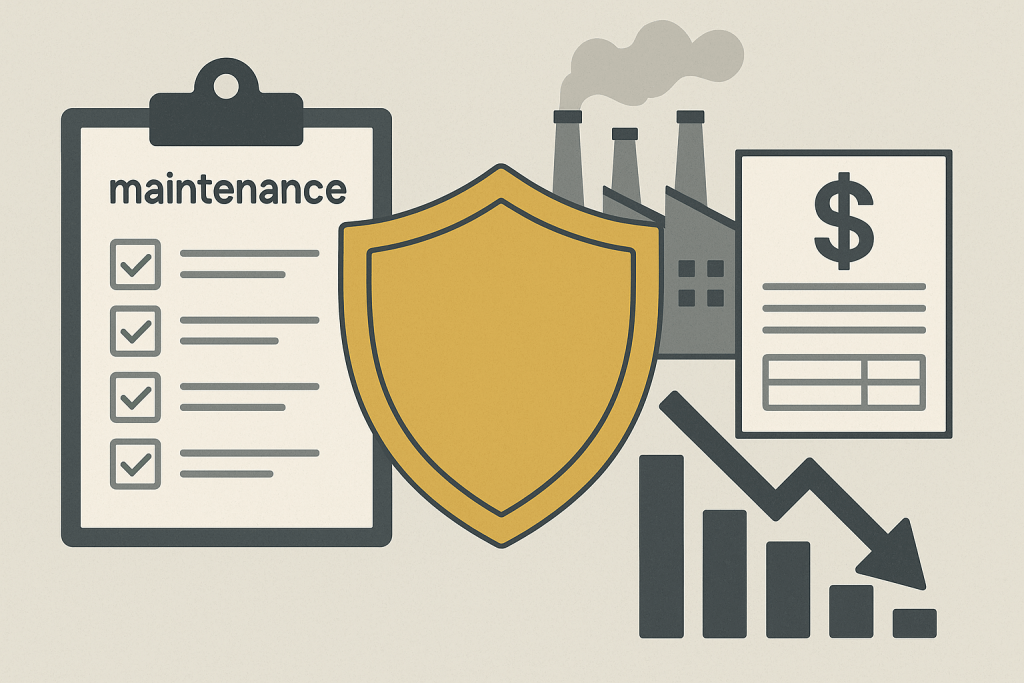
The truth is: your maintenance strategy is directly tied to the protection of your balance sheet.
Assets Are Financial Commitments, Not Just Equipment
The equipment on your site isn’t just gear — it’s a capital investment. It carries expectations for performance, life span, and residual value.
When those assets are ignored until failure, three things happen:
- Their operational value decays faster than accounting depreciation
- Unseen liabilities (like safety risk or code violations) accumulate
- The gap between “book value” and “real value” quietly grows
If you’re not maintaining proactively, you’re not protecting asset value — and you’re certainly not ready to defend it to your insurer, banker, or board.
Maintenance = Risk Mitigation
The best-run sites don’t view maintenance as a cost center — they view it as a control mechanism.
A strong preventive maintenance strategy:
- Defers capital replacement through extended life cycles
- Reduces operational risk and unplanned outages
- Creates a verified record of compliance and performance
When properly structured, maintenance becomes a financial shield — protecting not only uptime, but also the capital value that lives on your balance sheet.
Break-Fix Erodes Enterprise Value
Break-fix thinking is more than just a reactive operational approach — it’s a silent destroyer of enterprise value.
When you wait for things to break:
- Your capital planning becomes guesswork. Without real data on Remaining Operational Life, replacement requests become inflated, urgent, and hard to justify.
- Your insurance exposure increases. Without verified records of compliance, maintenance, or condition, premiums go up — or coverage is limited altogether.
- Your valuation takes a hit. Investors and strategic partners see untracked, unmanaged asset risk as a red flag — it signals lack of maturity and operational discipline.
Even worse, break-fix models often mask systemic issues. Failures are treated as isolated incidents rather than signals of structural gaps. Over time, this erodes trust — from your internal leadership, your financial partners, and your customers.
These aren’t hypotheticals. They are real, measurable financial consequences — and they all originate from a lack of governance around asset maintenance.
The First Step to Balance Sheet Protection
You don’t need to overhaul your capital plan overnight. But you do need to ask:
Is our maintenance strategy protecting our financial future — or just reacting to today’s problems?
The first step out of break-fix isn’t about buying software. It’s about reframing maintenance as a form of financial protection.
This is the foundation. In the next post, we’ll look at the unseen liabilities hiding in your asset portfolio — and why ignoring them could be your biggest blind spot.
If you’re ready to start protecting your balance sheet through better maintenance strategies, contact us at inZpire to learn more.